
Key facts at a glance
- Operator: Washington State Department of Transportation (WSDOT)
- Size: 21 vessels, 20 terminals, 8 routes; largest ferry system in the U.S.
- Ridership: 20.1 million in 2025; about 42,500 per weekday in early 2026
- Reservable routes: Anacortes–San Juan Islands and Port Townsend–Coupeville only
- Reservation cost: Free; holds part, not all, of each sailing
- Payment: Visa, Mastercard, Amex, Discover, and cash; 3% surcharge on card payments since March 1, 2026
- Real-time map: VesselWatch on the WSDOT site, plus terminal cameras
- Suspended service: Anacortes–Sidney, B.C. (out until at least spring 2030)
- Official schedule and booking: WSDOT ferries website
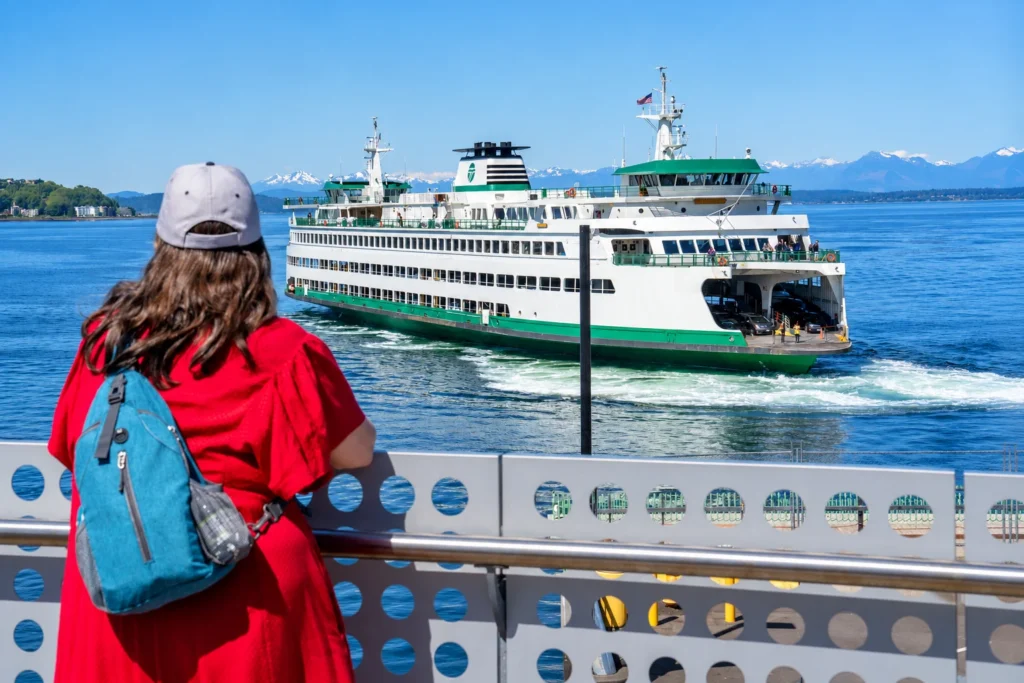
Planning a Washington State Ferries trip comes down to two questions: does your route take vehicle reservations, and how much slack should you leave for a boat that might not sail? Only two routes let you reserve a car space. The rest run first-come, first-served, and a chunk of every sailing is held for drive-up traffic even on the reservable ones. Get those two facts right, and most of the stress disappears.
Washington State Ferries (WSF) is the largest ferry system in the United States. In 2025 it carried 20.1 million riders across Puget Sound and out to the San Juan Islands, and it averaged about 42,500 riders every weekday in early 2026. It runs 21 vessels between 20 terminals, which sounds like plenty until you learn that eleven of those boats are older than 40 years and the system says it needs 26. That gap is the thread running through everything below: the schedule, the reservation rules, the fares, and the news.
Which routes does Washington State Ferries run?
Eight routes connect the mainland to the islands and peninsulas around Puget Sound and the Salish Sea. Two of them take vehicle reservations. The other six load on a drive-up basis.
Here is the network at a glance:
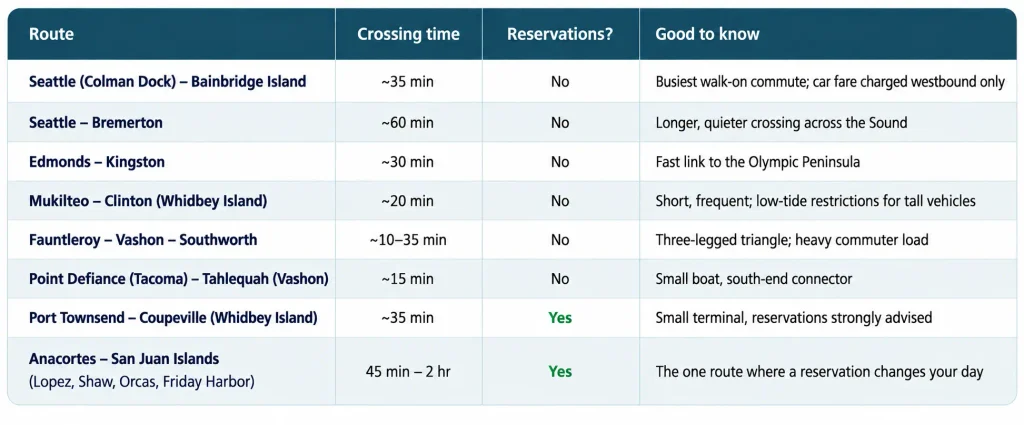
There is also a San Juan inter-island ferry that hops between Lopez, Shaw, Orcas, and Friday Harbor. It does not take reservations and usually does not need them. Walk-on passengers ride the inter-island boat for free.
One route is missing that older guides still list. International service between Anacortes and Sidney, British Columbia, has been suspended since 2020 because of vessel shortages, and WSF does not expect it back until at least spring 2030. If a blog promises you a ferry to Vancouver Island from Anacortes, it is out of date.
Do I need a car on the ferry?
For a day trip to Bainbridge or Bremerton, skip the car. Winslow, the town at the Bainbridge dock, sits steps from the terminal and is walkable. Walk-on passengers never need a reservation, board faster, and pay less. Bring a car only when your destination is spread out, which is the case for most San Juan trips and Whidbey Island stops away from the terminal.
How do I find the Washington State Ferries schedule?
The official sailing schedule lives on the WSDOT ferries site, searchable by route or by date. WSF publishes seasonal schedules rather than one fixed year-round timetable, so the summer sailing schedule differs from the fall and winter ones. Summer runs roughly mid-June through mid-September and packs in the most departures.
Two schedule features matter more than the raw departure list:
Best travel times. Each route page has a “best times to travel” view that flags the sailings least likely to leave you waiting through a boat or two. On commuter routes the mid-morning and mid-afternoon sailings clear faster than the rush-hour ones. On the San Juan run, the early-morning boats fill last.
Low-tide warnings. On the Mukilteo–Clinton and Vashon routes, extreme low tides steepen the loading ramps enough that WSF restricts long or low-clearance vehicles. If you drive an RV, a trailer, or a lowered car, check the low-tide warning before you commit to a specific sailing. Scraping your undercarriage on a ramp is a real risk here, not a hypothetical.
Sailings shift with vessel availability, which in 2026 is less predictable than riders would like. Check the schedule the day you travel, not only the week before.
How do Washington State Ferries reservations work?
Vehicle reservations apply to two routes only: Anacortes–San Juan Islands and Port Townsend–Coupeville. Reservations are free. They save a vehicle space on a specific sailing so you are not gambling on a drive-up room. Walk-on passengers and cyclists never reserve; they board on a space-available basis, which almost always means they get on.
The part most tourist blogs get wrong is that a reservation does not book the whole boat. WSF holds part of every sailing open for drive-up traffic.
The tier system, explained
Reservation space opens in stages instead of all at once, so both a family planning five months out and a local deciding the night before have a shot.
On the Anacortes–San Juan Islands route, about 75 percent of each sailing’s vehicle space can be reserved. The remaining 25 percent stays open for standby and emergency vehicles. That reservable block releases in tiers: a first portion opens two months before each seasonal schedule starts, more opens closer in, and a final slice opens two weeks out. You can grab a reservation up to about two hours before a sailing if space remains.
On Port Townsend–Coupeville, roughly 80 percent of spaces are reservable, and 20 percent are held back. Reservations open two months before the season starts at 10 a.m. Pacific.
For the current fall season, WSF opened autumn reservations covering September 20 through December 26 at 10 a.m. on July 21, 2026. Winter reservations open in late October. If your dates are set, book the moment your tier opens. Summer San Juan sailings on peak weekends sell their reservable space fast.
How to make a reservation, step by step
- Go to the WSF vehicle reservation system on the WSDOT site and pick your route, date, and sailing.
- Enter your vehicle length. Fares and space depend on it, and a reservation for the wrong length can be rejected at the booth.
- Confirm and save your confirmation email. Text confirmations ended in 2025 because phone carriers stopped supporting email-to-text, so email is now the only notification channel.
- Reserve the return leg too. This is the single most common mistake.
- At the terminal, arrive inside the check-in window 30 minutes before the boat at Port Townsend and 45 to 60 minutes before at Anacortes. Bring the confirmation to scan at the tollbooth.
What is the no-show fee, and how do I avoid it?
If you hold a reservation and do not show, WSF charges a no-show fee scaled to your vehicle size. Two situations trip people up.
The first is the return leg. If you cancel or change your outbound trip but forget the return, the system still expects you on that return sailing and bills the no-show fee when you miss it. Change both legs together.
The second is arriving late. If you miss your reserved sailing but still make it to the terminal, tell the tollbooth you had a reservation. They can move you to standby on the next available boat without charging the fee. Say nothing and you may eat the charge.
One relief valve: if WSF cancels your sailing, you owe nothing. Cancellations from crew shortages or mechanical problems are the agency’s cost, not yours.
How much are Washington State Ferries tickets?
Fares depend on the route, whether you walk on or drive, and your vehicle’s length. A few structural quirks are worth knowing before you budget.
Cross-sound fares are collected in one direction. On the Seattle–Bainbridge route, for example, WSF charges the fare westbound, and the eastbound trip back to Seattle costs nothing. Do not double your estimate for a round trip on these routes.
Vehicle fares rise with length. A standard car under 22 feet pays the base vehicle rate. Anything 22 feet and longer, including trailers and towed loads, moves into length-based pricing that climbs with each foot and with height. Oversize vehicle fares are not sold online; you pay those at the terminal.
Rough one-way ranges to plan around before surcharges:
| Trip type | Approximate one-way cost |
| Walk-on passenger, short sound route | ~$6–$10 |
| Car and driver, short sound route | ~$15–$20 |
| Car and driver, Anacortes–San Juan Islands | ~$40–$65 |
| Oversize vehicle or RV, longer route | $90+ |
Treat these as estimates and confirm the exact fare on the route’s fare page before you travel, since several surcharges changed in 2025 and 2026.
What changed about fares in 2026?
The Washington State Ferries Transportation Commission approved a fare increase of about 3 percent on October 1, 2025, and another 3 percent on May 1, 2026. On top of that:
- The summer peak-season surcharge rose to 35 percent on all routes, matching what the San Juan routes already charged. Peak season runs May 1 through September 30.
- The vessel replacement surcharge climbed to $1 per ticket as of October 1, 2025.
- A 3 percent cost-recovery surcharge now applies to any ticket bought with a credit or debit card, effective March 1, 2026. The state legislature directed this fee so WSF could recover card-processing costs.
- Multi-ride passes, which bundle ten round trips, now stay valid for 120 days instead of 90, a trial change that started in May 2026.
WSF accepts Visa, Mastercard, American Express, and Discover, plus cash at the terminals. If you ride often, a multi-ride pass beats single tickets, and paying cash sidesteps the new card surcharge.
Where is the Washington State Ferries real-time map?
WSF runs a live vessel map called VesselWatch on the WSDOT site. It shows every underway ferry’s position, route, heading, and speed and flags any vessel running more than ten minutes late. You can switch the view to a single route, follow one boat, or pull up terminal cameras that show the holding lanes so you can gauge the wait before you leave the house.
The terminal cameras are the underused tool here. On a drive-up route with no reservations, the camera showing a full holding lot tells you to catch a later boat far better than any schedule does.
Several third-party apps pull the same live data into a cleaner phone interface, with widgets, watch support, and space-availability estimates. If you commute on a WSF route, a dedicated app is worth the download. For a one-off trip, the WSDOT map and camera pages do the job.
Washington State Ferries news and updates in 2026
The story of the year is an aging fleet meeting new construction, with reliability caught in the middle.
The new boats finally started. On August 5, 2026, crews at Eastern Shipbuilding Group in Panama City, Florida, cut the first steel for WSF’s first new ferry in eleven years. The state ordered three hybrid-electric vessels for about $1.15 billion, each built to carry 160 vehicles and 1,500 passengers. Deliveries are scheduled for 2030, 2031, and 2032, and the first is named Wishkah. Each vessel carries two diesel engines, two electric motors, and battery banks and can run on electricity, diesel, or both. WSF estimates the new boats and terminal charging could cut systemwide greenhouse gas emissions by 75 to 95 percent over time.
The fleet is straining in the meantime. The year opened badly: one vessel was pulled from service on each of the first three days of January 2026, including the Walla Walla, which lost a propeller blade on New Year’s Day and went to emergency dry dock. Eleven of the 21 boats have reached or are nearing the end of their planned 60-year lives, and one is 67 years old. Governor Bob Ferguson has made restoring reliable service a priority, and a return to 18-boat operation helped push 2025 ridership back to 20.1 million. But crew shortages, not only old engines, still cause cancellations, and the fix depends on paying licensed mariners enough to keep them from private shipping jobs.
Hybrid conversions are on pause. WSF’s largest vessels, the Jumbo Mark II class, produce a quarter of the system’s emissions and were slated for hybrid-electric conversion. The first converted boat, the Wenatchee, returned in July 2025 as the largest hybrid-electric passenger vessel in North America, then went back out for repairs more than once. Ferguson delayed converting the remaining large vessels until after the FIFA World Cup matches in summer 2026, keeping more boats in the water for the crowds.
The reservation system overhaul stalled, then reset. In April 2026, WSF terminated its contract to modernize the ticketing and reservation systems. The agency still plans a modern platform with features like tap-to-pay, with a launch no earlier than late 2026. The reservation rules and no-show fees are not changing with it; only the tools are.
Cross-border service is still gone. Spring 2026 marked the seventh season without the Anacortes–Sidney, B.C., run. A state ferry workgroup was directed to report findings and recommendations by December 15, 2026, which may shape what the system looks like later this decade.
For day-to-day updates, WSF posts travel alerts by route and sends email notifications for service changes. Sign up for alerts on the routes you use rather than checking a news page; a canceled sailing shows up in an alert hours before it reaches a headline.
Tips riders learn the hard way
A few things that separate a smooth crossing from a missed boat:
- Arrive earlier than you think on summer weekends. For San Juan sailings on a busy holiday weekend, an hour ahead is not overcautious.
- Standby is a real option. WSF loads 20 to 30 extra vehicles on many San Juan sailings from the standby line, because reservation holders no-show. If you could not get a reservation, showing up early for standby often works.
- Eat before you line up, or bring food. Once your car is in the holding lane, you wait with it. On the longer San Juan crossings there is galley food aboard, though regulars rate BC Ferries’ food higher.
- Watch the tide if you drive anything long or low. The low-tide restrictions on Mukilteo and Vashon are there because vehicles get stuck on the ramps.
- Consider going car-free to the San Juans. Leave the car in Anacortes, walk on, and rent a bike or use island transit. You skip the reservation gamble entirely and the walk-on fare is a fraction of the vehicle fare.
FAQs
Q. Do I need a reservation for Washington State Ferries?
A. Only on two routes: Anacortes–San Juan Islands and Port Townsend–Coupeville, and only if you are bringing a vehicle. Every other route loads drive-up, and walk-on passengers never reserve. Even on reservable routes, part of each sailing is held for standby, so no reservation does not mean no ride.
Q. How early should I arrive at the terminal?
A. For drive-up routes, 30 to 45 minutes ahead in normal conditions and more on summer weekends. For a reserved San Juan sailing, arrive 45 to 60 minutes early; for Port Townsend, 30 minutes. Walk-on passengers need only enough time to buy a ticket and reach the boat, usually 15 to 20 minutes.
Q. How much does the ferry cost with a car?
A. It depends on the route and your vehicle length. Short Sound crossings run roughly $15 to $20 for a car and driver one-way, while Anacortes to the San Juans runs closer to $40 to $65. Cross-Sound routes like Seattle–Bainbridge charge only in one direction, so your return can be free. Confirm the exact fare on the route’s fare page, since surcharges changed in 2026.
Q. Can I track the ferry in real time?
A. Yes. The VesselWatch map on the WSDOT site shows live vessel positions, speeds, and delays, and terminal cameras show how full the holding lanes are. Third-party apps repackage the same data with alerts and space estimates.
Q. Why do Washington State Ferries get canceled so often?
A. Two reasons: an aging fleet and crew shortages. Eleven of 21 vessels are past 40 years old, and mechanical failures pull boats without warning. When a sailing is canceled, reservation holders are not charged a no-show fee, and you keep priority once service resumes.
Q. Is there still a ferry to Canada?
A. Not from Anacortes. The Anacortes–Sidney, B.C. route has been suspended since 2020 and is not expected back until at least spring 2030. Private operators run other cross-border options, but they are not part of Washington State Ferries.