
Disclaimer:Distances here are typical ranges and worked examples for trip planning. Real figures vary by ship, weather and itinerary, so check your cruise line’s schedule and our Disclaimer.
Quick answer:A cruise ship sailing a full day at its usual 18 to 22 knots covers about 430 to 530 nautical miles, or roughly 500 to 610 land miles (800 to 980 km). On port days it usually sails only overnight, so it often covers 150 to 300 nautical miles.
The honest answer to how far can a cruise ship travel in a day depends on which kind of day you mean. On a sea day, the ship runs for 24 hours straight. On a port day, it spends the daylight hours tied up at a pier and sails only after you’re back on board. The gap between those two days is bigger than most people expect. Our sea-travel guides always start with the math, so that’s where this one starts too. Distances below are in nautical miles first, because that’s what the bridge uses, with land miles and kilometers next to them.
Cruise ship daily distance at a glance
| Day type | Hours under way | Typical speed | Distance (nautical miles) | Land miles | Kilometers |
|---|---|---|---|---|---|
| Full sea day | 24 | 18 to 22 knots | 432 to 528 | 497 to 608 | 800 to 978 |
| Overnight port-to-port leg | 12 to 15 | 12 to 20 knots | about 150 to 300 | about 170 to 345 | about 280 to 555 |
| Top-speed day (rare) | 24 | 23 to 25 knots | 552 to 600 | 635 to 690 | 1,022 to 1,111 |
Source: calculated as speed in knots x hours under way; 1 nautical mile = 1.15078 land miles = 1.852 km.
How Far Can a Cruise Ship Travel in a Day at Normal Cruising Speed?
At 18 to 22 knots, a cruise ship covers 432 to 528 nautical miles in 24 hours. That’s about 500 to 610 land miles. Royal Caribbean says its ships average “about 18 to 20 knots depending on the ship and itinerary,” which puts a typical sea day for its fleet at 432 to 480 nautical miles.
The math is one line. Multiply the speed in knots by the hours the ship is moving:
Distance (nautical miles) = speed (knots) x hours under way
Cruise Ship Daily Distance Calculator
Enter the ship’s speed in knots and the hours it sails. Try 24 hours for a sea day or 12 to 15 for an overnight port-to-port leg.
| Speed | Nautical miles per day | Land miles per day | Kilometers per day |
|---|---|---|---|
| 16 knots | 384 | 442 | 711 |
| 18 knots | 432 | 497 | 800 |
| 20 knots | 480 | 552 | 889 |
| 22 knots | 528 | 608 | 978 |
| 24 knots | 576 | 663 | 1,067 |
Source: calculated as knots x 24 hours.
A ship at 20 knots moves about as fast as a car on a quiet side street, but it keeps that pace all night while you sleep. For the full breakdown of knots, mph and top speeds by ship, see our guide to how fast cruise ships go in knots and mph.
Nautical Miles vs Land Miles: Why the Numbers Look Different
A nautical mile is exactly 1,852 meters, or about 1.15 land miles. That’s why the same day at sea can be “480 miles” on the ship’s map and “552 miles” in a news story. Both are right; they use different miles. Ships use nautical miles because one nautical mile matches one minute of latitude on a chart, so officers can measure distance straight off the map. A knot is one nautical mile per hour.
How Far Does a Cruise Ship Travel on a Sea Day vs a Port Day?
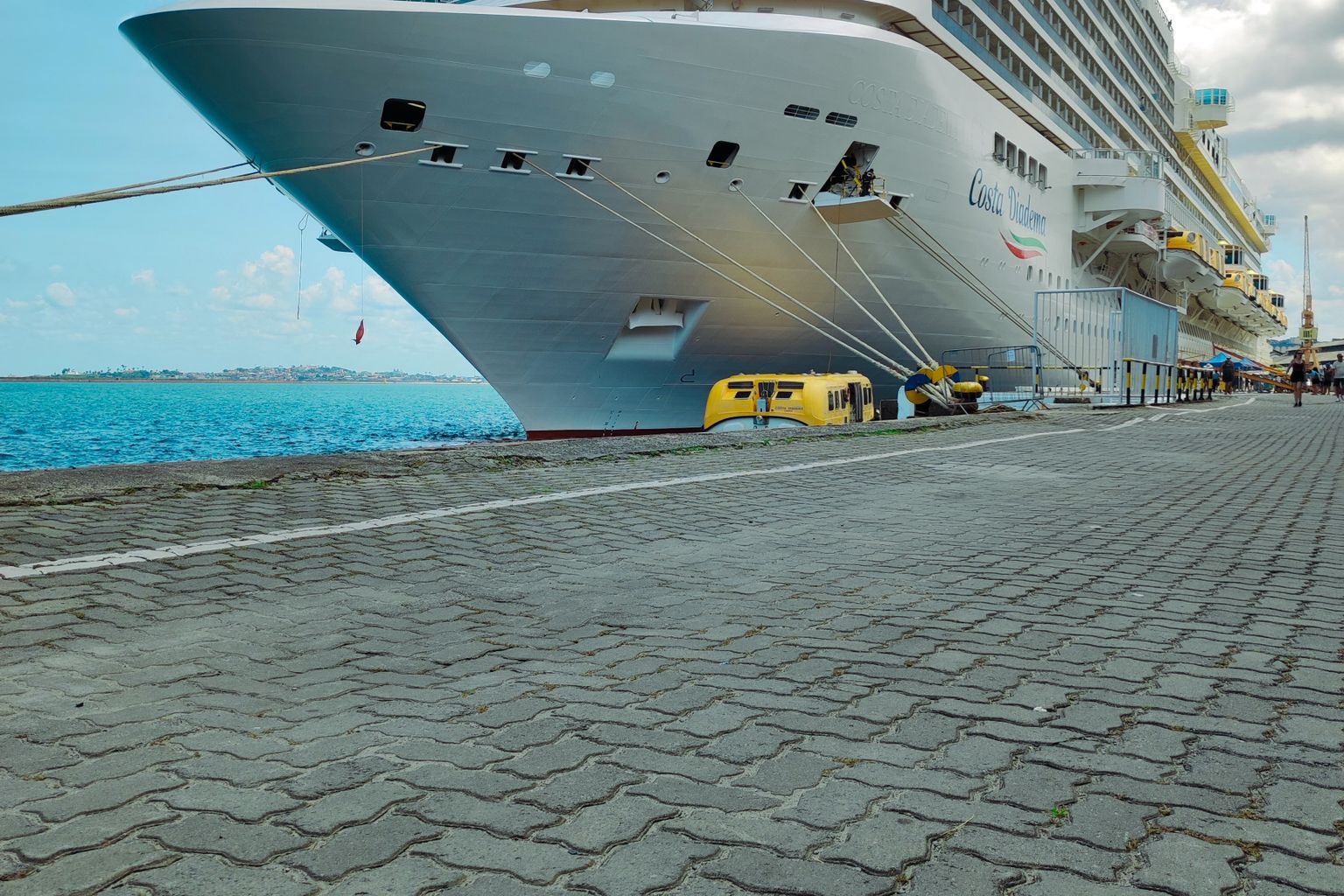
A sea day gives the ship about 24 hours under way, so it covers 430 to 530 nautical miles. A port day leaves only the overnight hours, often 12 to 15, so the ship covers far less, usually 150 to 300 nautical miles. Your itinerary’s port list tells you which kind of day you’re getting.
| Day type | Hours under way | Speed used | Distance |
|---|---|---|---|
| Sea day | about 24 | steady cruising speed, 18 to 22 knots | 432 to 528 nm |
| Port day | about 12 to 15 | whatever gets the ship to the next port on time, often 12 to 20 knots | about 150 to 300 nm |
Source: calculated as knots x hours under way.
Sea Days: A Full 24 Hours Under Way
On a sea day, the ship has a long leg ahead and holds a steady cruising speed from midnight to midnight. That’s when the big numbers happen: two back-to-back sea days at 20 knots add up to about 960 nautical miles. Even then, the captain plans the speed around the arrival time. A ship that’s ahead of schedule slows down to save fuel, so a sea day can land closer to 400 nautical miles than 500. Long sea days are also when the pools, shows and bars stay busiest, so count your sea days before you choose onboard extras.
Port Days: Sailing Overnight Between Ports
On a port day, the ship sails out in the evening and arrives the next morning. Leaving and entering a harbor takes time at slow speed, and a local pilot often boards to guide the ship in and out. The short legs mean the ship rarely needs full cruising speed. Miami to Nassau is only 191 nautical miles, according to the NGA’s Distances Between Ports (Pub. 151). A ship with 15 hours to cover that leg needs only about 13 knots. At 18 knots, 15 hours of sailing would cover 270 nautical miles, so the ship has time to spare.
How Many Miles Does a Cruise Ship Travel in a Day on Real Itineraries?

Real routes show the range clearly: a short Caribbean hop like Miami to Nassau is 191 nautical miles, while Seattle to Juneau is 879 and Los Angeles to Honolulu is about 2,233. The longer the leg, the more full sea days a cruise needs, at roughly 430 to 530 nautical miles each.
| Route | Distance (nautical miles) | Land miles | Hours at 20 knots | Source |
|---|---|---|---|---|
| Miami to Nassau | 191 | 220 | about 10 | NGA Pub. 151 |
| Seattle to Juneau (Inside Passage) | 879 | 1,012 | about 44 | NOAA Distances Between United States Ports |
| Los Angeles to Honolulu | about 2,233 | about 2,570 | about 112 | NOAA Distances Between United States Ports |
| Southampton to New York | about 3,169 | about 3,647 | about 158 | NGA Pub. 151 (232 + 2,937 via Bishop Rock) |
Source: distances from official port-distance tables; land miles and hours calculated. Real cruise tracks can differ from these fixed port-to-port routes.
Cruise Leg Sailing Time Calculator
Pick a route from the table above and a speed to see how long the leg takes without stops.
Short hops: Miami to Nassau fits inside one night with plenty of slack, so the ship sails slowly and arrives on time for breakfast.
Alaska and Hawaii: Seattle to Juneau runs 879 nautical miles through the Inside Passage, according to NOAA’s Distances Between United States Ports (2026 edition). That’s about 44 hours at 20 knots, close to two full days of sailing. Los Angeles to Honolulu, at about 2,233 nautical miles in the same NOAA tables, takes about 112 hours at 20 knots, or more than four and a half days.
Ocean crossings: Queen Mary 2’s Southampton to New York crossing covers about 3,169 nautical miles by the NGA tables. Spread over seven days, that’s about 453 nautical miles a day, or an average near 19 knots.
What Affects How Far a Cruise Ship Travels in a Day?
The biggest factor is the schedule: a ship sails as fast as it needs to reach the next port on time, and no faster. Weather, currents, speed-limit zones and fuel cost then push the daily distance up or down from the 430 to 530 nautical mile sea-day range.
- Itinerary timing: short legs get slow speeds; long legs get full cruising speed. The arrival time comes first and the speed follows.
- Weather and sea state: strong headwinds and high waves slow a ship down. Captains may also change course around a storm, which adds miles.
- Currents: a favorable current adds a knot or two of free speed, and a current against the ship takes it away. Over 24 hours, one knot is 24 nautical miles.
- Speed-limit zones: NOAA Fisheries says most vessels 65 feet or longer “must travel at 10 knots or less” in Seasonal Management Areas off the US East Coast to protect North Atlantic right whales. A proposal to widen that rule was withdrawn on January 16, 2025, and the existing limits stay in effect. In Alaska, a National Park Service update effective August 6, 2026 keeps a 13-knot limit in parts of Glacier Bay’s Lower Bay Whale Waters and Queen Inlet.
- Fuel cost: fuel burn climbs quickly as speed rises, so lines plan legs that let ships cruise below their top speed.
- Ship design: an ocean liner such as Queen Mary 2 is built for speed on long crossings. Modern megaships, like those on our list of the biggest cruise ships, are built for space and stability on shorter routes.
How Far Can a Cruise Ship Travel in a Day at Top Speed?
Most modern cruise ships top out around 23 to 25 knots, so in theory they could cover about 550 to 600 nautical miles in 24 hours. That’s roughly 635 to 690 land miles. In practice, lines rarely use top speed for a whole day, because the fuel cost is high and schedules leave room to spare.
Top speed is kept in reserve. A captain uses it to make up time after bad weather, a late departure or a medical diversion. Queen Mary 2 is the usual exception, since an ocean liner’s hull is built to hold high speed on the open Atlantic. For the listed top speeds of individual ships, check our guide on how fast cruise ships go.
How Far Can a Cruise Ship Go Without Refueling?
A cruise ship’s range without refueling depends on its fuel capacity, its speed and how much power the hotel side of the ship uses, so there’s no single number for every ship. Cruise lines don’t usually publish a range figure for each ship.
Speed is the part you can see from the itinerary. Running faster burns fuel much faster, which is the same reason container lines cut their speeds to save fuel. A ship that cruises at 18 knots goes much farther on one tank than the same ship pushed to 24 knots. Ships take on fuel in port, a process called bunkering, so range rarely limits a normal cruise.
How Does a Cruise Ship Compare With a Cargo Ship or Ferry in a Day?
A cruise ship at 18 to 22 knots covers about 432 to 528 nautical miles a day, while a slow-steaming container ship at 18 knots or less covers about 432 or fewer. Ferries run short routes in hours.
| Vessel | Typical speed | Distance in 24 hours |
|---|---|---|
| Cruise ship | 18 to 22 knots | 432 to 528 nm |
| Ocean liner (Queen Mary 2, Atlantic crossing average) | about 19 knots | about 453 nm |
| Container ship (slow steaming) | 18 knots or slower | 432 nm or fewer |
| High-speed ferry (Key West Express) | speed not published | about 3.5 hours per crossing |
Source: cruise ship and ocean liner calculated from the tables above; container ship from Notteboom, Pallis and Rodrigue, Port Economics, Management and Policy; ferry from the operator’s website.
Container lines cut their speeds from 22 to 23 knots down to 18 knots or slower to save fuel, according to the textbook Port Economics, Management and Policy. The Key West Express plans on about 3.5 hours between Fort Myers Beach and Key West, as our high-speed ferry to Key West review covers.
So, How Far Can a Cruise Ship Travel in a Day?
A cruise ship travels about 430 to 530 nautical miles on a full sea day, roughly 500 to 610 land miles or 800 to 980 km. That range comes from a steady cruising speed of 18 to 22 knots held for 24 hours. On a port day, the ship spends the daylight hours at the pier and sails only overnight, so it usually covers 150 to 300 nautical miles. Short legs like Miami to Nassau, at 191 nautical miles, leave so much slack that a ship can sail at about 13 knots and still arrive for breakfast. Top speed rarely comes into it, because schedules, weather, currents and speed-limit zones decide the real number more often than the engines do.
To estimate your own trip, start with the itinerary. Count the sea days and multiply each one by about 480 nautical miles, the distance a ship covers at 20 knots in 24 hours. Then add the port-to-port legs, using official distances like the ones in the route table above, or put any speed and sailing time into the calculator. A Caribbean cruise with two sea days covers about 960 nautical miles on those two days alone, while an Alaska or Hawaii sailing adds long open-water legs of 879 to more than 2,200 nautical miles. The answer for your cruise will sit somewhere between a slow Caribbean night and a full Atlantic day, and the math above shows you where.
Frequently Asked Questions
Q1:How far can a cruise ship travel in 24 hours?
A:A cruise ship can travel about 432 to 528 nautical miles in 24 hours at its usual cruising speed of 18 to 22 knots. That’s roughly 500 to 610 land miles, or 800 to 980 km. A ship at 20 knots covers 480 nautical miles, or about 552 land miles, in a full day.
Q2:How far does a cruise ship travel overnight?
A:A cruise ship usually travels about 150 to 300 nautical miles overnight between two ports. It sails for 12 to 15 hours at 12 to 20 knots, depending on how far the next port is. Miami to Nassau, for example, is only 191 nautical miles, so the ship can sail slowly and still arrive on time.
Q3:How far can a cruise ship travel in a day without stopping?
A:Without stopping, a cruise ship covers the same distance as a sea day: about 432 to 528 nautical miles in 24 hours at 18 to 22 knots. At a top speed of 23 to 25 knots, it could reach about 550 to 600 nautical miles, but lines rarely sail that fast for a full day.
Q4:Do cruise ships go faster at night?
A:Cruise ships usually don’t go faster at night. Most of a port-intensive cruise’s sailing happens overnight, but the legs are short, so ships often sail below cruising speed and time their arrival for the morning. On sea days, the ship holds a steady speed day and night.
Q5:How much fuel does a cruise ship use per mile?
A:Fuel use per mile changes with the ship’s size, its speed and the weather, so there’s no single figure for every ship. Speed matters most: a ship burns fuel much faster at top speed than at an 18 to 20 knot cruising speed, which is why lines plan routes below top speed.
Q6:How long does it take a cruise ship to cross the Atlantic?
A:Queen Mary 2’s Southampton to New York route is about 3,169 nautical miles by official port-distance tables. Over a seven-day crossing, that’s about 453 nautical miles a day, an average near 19 knots. Repositioning cruises take longer because they stop at ports along the way.
Q7:Is a cruise ship faster than a cargo ship?
A:A cruise ship is usually a bit faster than a container ship. Cruise ships average 18 to 22 knots, while many container lines slowed their ships to 18 knots or less to save fuel. A cruise ship can cover about 432 to 528 nautical miles a day, compared with 432 or fewer.
Q8:How can I track how far my cruise ship has traveled?
A:Most cruise ships show the ship’s position, speed and heading on a navigation channel on the cabin TV or in the cruise line’s app. Public ship-tracking websites that use AIS, the radio signal ships broadcast, also show a ship’s position and route, so friends at home can follow along.