

Quick answer: Most cruise ships sail at 18 to 22 knots, which is about 21 to 25 mph or 33 to 41 km/h. Many can push to 23 to 25 knots when they need to. Cunard lists its ocean liner Queen Mary 2, the usual answer to “fastest cruise ship,” at 28 knots (about 32 mph).
Stand on a cruise ship’s top deck on a sea day and the ocean seems to slide past slowly. Ask a crew member how fast do cruise ships go, and you’ll get an answer in knots. A typical cruise ship sails at about 20 knots, which is roughly 23 mph, about the pace of a car on a quiet neighborhood street. That speed is a choice the cruise line makes, and the reason comes down to fuel.
Cruise ship speed at a glance
How Fast Do Cruise Ships Go in Knots, MPH and km/h?
Most cruise ships cruise at 18 to 22 knots, or about 21 to 25 mph (33 to 41 km/h). That is the planned speed in open water, once the ship has cleared the harbor. As the Royal Caribbean Blog puts it, “Royal Caribbean says its cruise ships go as fast as 18 to 20 knots, depending on the specific ship and itinerary travelled.” That works out to about 20 to 23 mph.
The word “average” matters here. A cruise line plans each leg of a trip around a cruising speed, and the ship holds roughly that pace for hours at a time. The ship can go faster, but the line rarely asks it to. Speeds drop well below the average inside ports, and they rise a little when a ship has time to make up after bad weather. So the number on the bridge changes through the day, while the average for the whole trip stays close to the figure the line publishes.
Here’s how the common cruise ship speeds convert:
A ship at 20 knots covers a mile of ocean in under three minutes. That sounds slow next to a highway, yet the ship keeps it up all night while you sleep.
What Is a Knot?
A knot is a speed of one nautical mile per hour. Cruise Mummy’s knots explainer puts it plainly: “A knot is a measurement of 1 nautical mile per hour.” NOAA puts one knot at roughly 1.15 statute mph. A nautical mile is 1,852 meters, or about 6,076 feet, so it’s a little longer than the 5,280-foot mile on your car’s odometer.
Sailors use the nautical mile because it lines up with the map. One nautical mile matches one minute of latitude, so a ship’s officers can measure distance straight off a chart. Speed in knots then tells them how many of those chart miles the ship covers each hour.
Converting knots is quick math:
- Knots to mph: multiply by 1.15. So 20 knots is about 23 mph.
- Knots to km/h: multiply by 1.85. So 20 knots is about 37 km/h.
Once you know that rule, every speed a captain announces over the ship’s speakers makes sense.
What Is the Top Speed of a Cruise Ship?
Most modern cruise ships top out at about 23 to 25 knots (26 to 29 mph). Disney Wish, for example, has a listed service speed of 19.5 knots and a maximum of 23 knots. Royal Caribbean’s Harmony of the Seas cruises at 22 knots and can reach 25. Those top speeds stay in reserve, mostly for making up lost time.
Published speeds often disagree, and that confuses a lot of readers. We find it helps to sort every figure into what we call the three speeds of a cruise ship:
- Service speed: the steady pace the ship is built to hold on a normal trip. This is the number cruise lines usually quote.
- Maximum speed: the most the engines can deliver in good conditions. Ships rarely use it.
- Trial speed: the speed reached during sea trials, the test runs a shipyard makes before handing over a new ship. Trial figures show what the ship managed on test day.
When one website says a ship goes 22 knots and another says 25, both can be right. One quotes service speed and the other quotes maximum speed.
So can a cruise ship go 40 mph? No cruise ship in service today can. Forty mph is about 35 knots, and only a handful of record-breaking ocean liners ever reached that.
Top Speeds of Popular Cruise Ships
The popular ships below cruise at about 19.5 to 23 knots, and their listed top speeds sit only a few knots higher.
Two patterns stand out in that table. Every ship’s service speed lands between 19.5 and 23 knots, a spread of only 3.5 knots across four cruise lines. Where a maximum is listed, it sits 3 to 3.5 knots above the service speed: Harmony of the Seas goes from 22 to 25 knots, and Disney Wish goes from 19.5 to 23. That small gap is the cushion a captain has to make up for a late departure or a stormy night.
Icon of the Seas is one of the biggest ships afloat, yet its listed speed matches the much smaller Harmony of the Seas. Size and speed are separate questions, which our list of the biggest cruise ships sailing today makes clear. Royal Caribbean’s newer Star of the Seas is Icon’s sister ship in the same Icon class. Royal Caribbean hasn’t published a separate speed for it in the sources we checked.
Which Cruise Ship Is the Fastest in the World?
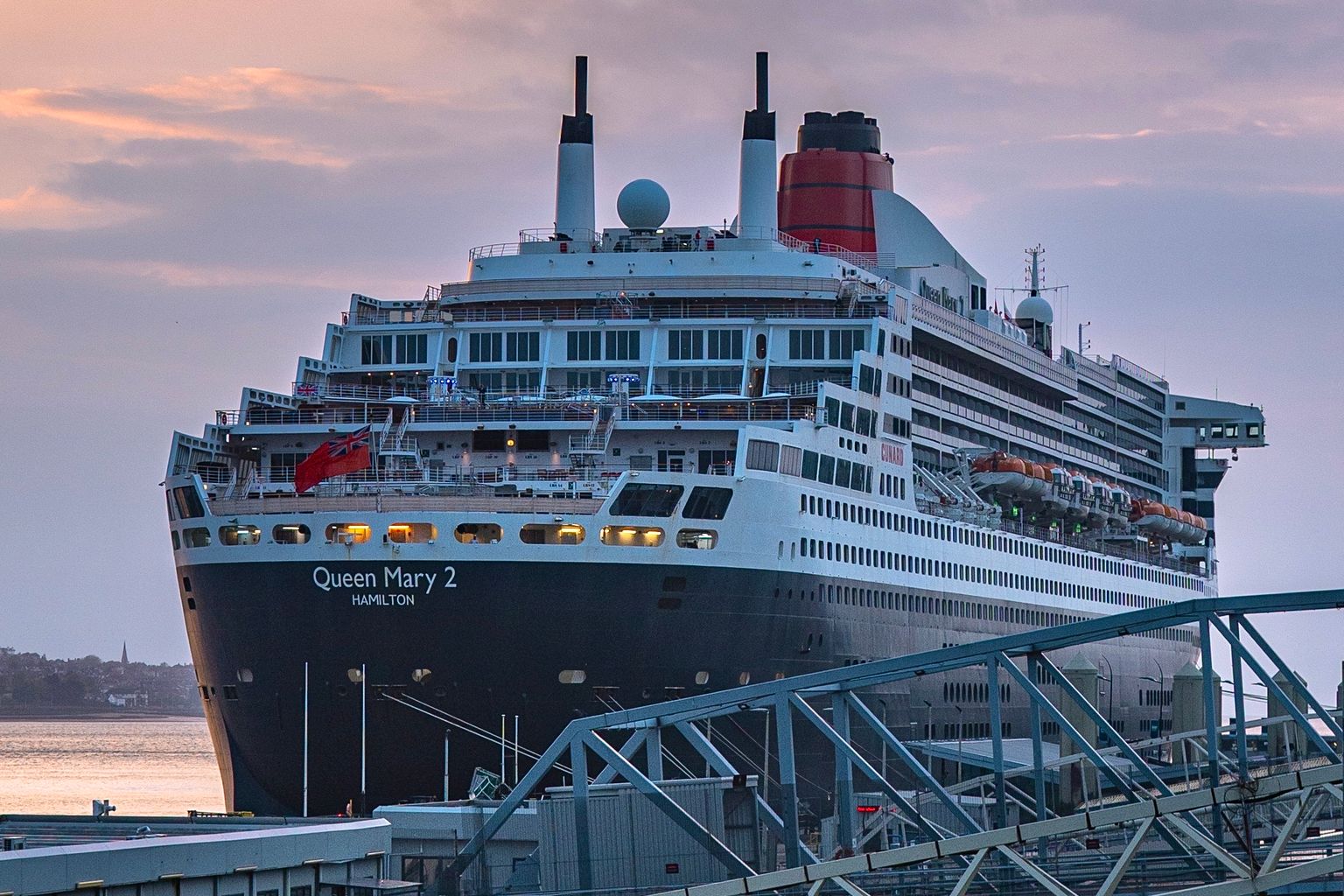
Cunard’s Queen Mary 2 is the usual answer. Cunard lists Queen Mary 2 at 28 knots, about 32 mph or 52 km/h. Wikipedia’s entry gives a 26-knot service speed and a maximum of just over 30 knots, and Cruise Critic gives the ship “a reported top speed of 30 knots, or 34.5 mph.” Under the three-speeds idea, Cunard’s 28 sits between the everyday pace and the absolute limit.
Queen Mary 2 is an ocean liner, which explains the extra speed. Cunard built it for regular crossings of the Atlantic Ocean, a route that needs a longer, sharper hull and more engine power than a Caribbean resort ship. Most cruise ships are built for calm, short hops between islands, so they don’t need that power.
The difference adds up over a day. At Cunard’s listed 28 knots, Queen Mary 2 covers about 672 nautical miles in 24 hours. A typical cruise ship at 22 knots covers about 528. That’s an extra 144 nautical miles, roughly 166 statute miles, every single day at sea.
No official record exists for “fastest cruise ship.” Lines publish different kinds of speeds, and they don’t race their ships to prove it.
Which Passenger Ship Holds the Speed Record?
SS United States holds the record. On its maiden voyage in July 1952, the American ocean liner crossed the Atlantic eastbound at an average of 35.59 knots, about 41 mph. That run won the Blue Riband, the prize for the fastest transatlantic crossing. A few weeks earlier, on June 10, 1952, the ship hit 38.32 knots (44.1 mph) on a full-power trial run. That trial speed is often wrongly quoted as its maiden-voyage speed. The record crossing itself took 3 days, 10 hours and 40 minutes, a pace no passenger ship has beaten since.
The ship retired in 1969. As of October 2026, it was docked in Mobile, Alabama. Okaloosa County, Florida, bought it in October 2024 to turn it into an artificial reef. CruiseHive reported in October 2026 that the ship will be sunk 22 nautical miles southwest of Destin-Fort Walton Beach, with the sinking targeted for the second week of November 2026.
Why Don’t Cruise Ships Sail at Full Speed?
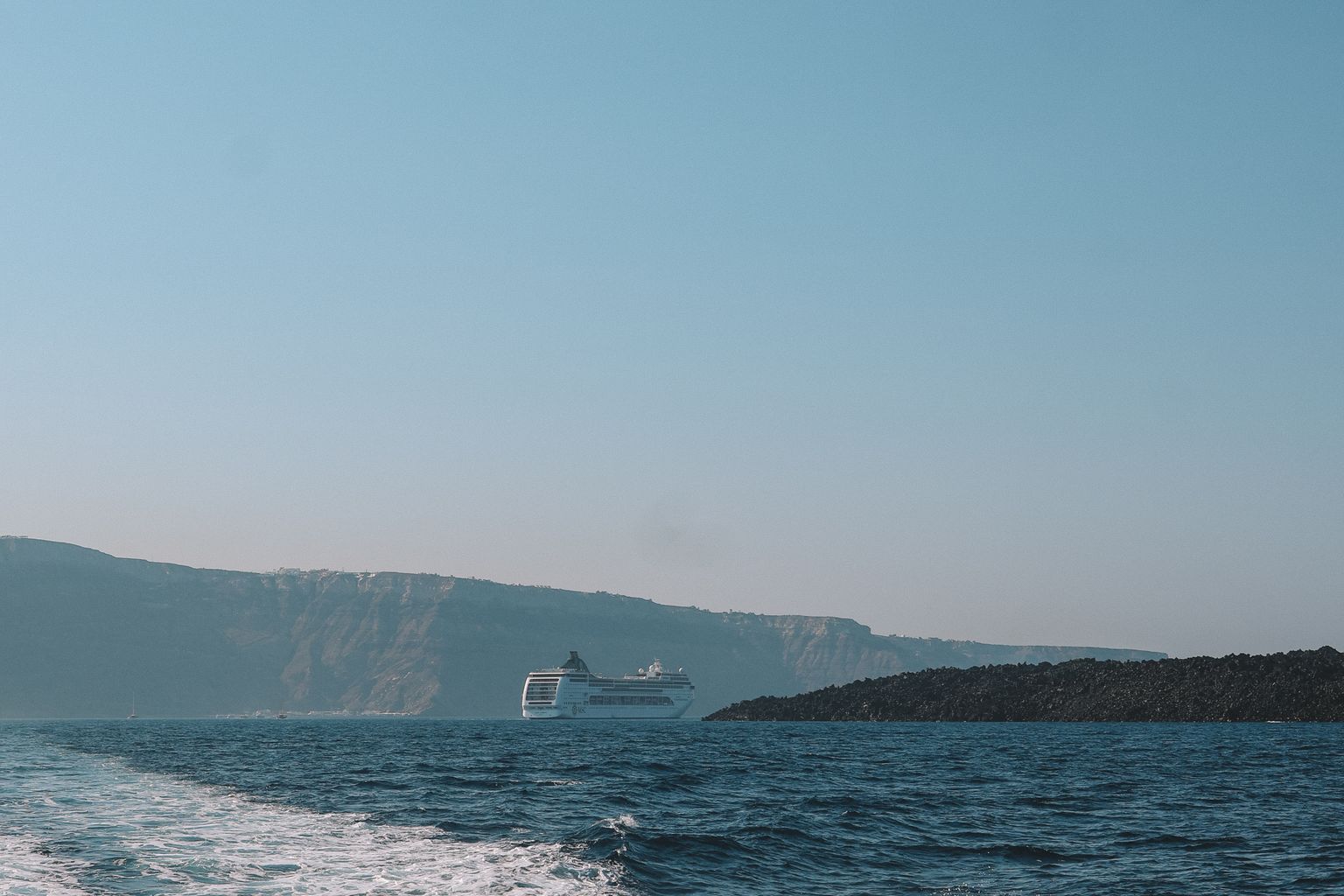
Cruise ships sail below full speed mainly because speed burns fuel fast, and a faster crossing doesn’t make the trip better for guests. A ship that arrives at 7 a.m. after a slow, smooth night is the goal. Running flat out would cost far more and get passengers to port too early.
Engineers ask the same thing that forum users ask: why haven’t high-speed cruise ships caught on? These five factors explain it.
- Fuel cost: Fuel use climbs steeply as speed rises. The IMO’s GreenVoyage2050 program uses a rule of thumb where engine power “follows the cube of speed,” and says a ship that slows by 10% “reduces the power need (resistance) and coherent fuel consumption for propulsion by 27%.” We applied that cube rule to a cruise ship. Dropping from 22 knots to 18 knots cuts the propulsion power needed by about 45%. Speed falls by less than a fifth, yet the engine load falls by close to half. That math explains why cruise lines treat a few extra knots as an expensive luxury they’d rather skip.
- Itinerary timing: Most Caribbean and Mediterranean ports sit a night’s sail apart. A ship leaving at 5 p.m. for a port 250 nautical miles away only needs about 18 knots to arrive by morning.
- Passenger comfort: Slower speeds mean less vibration and a gentler ride.
- Weather, sea state and currents: Headwinds, big swells and strong currents slow a ship down. Captains also ease off in rough seas to keep the ride smooth.
- Port approaches and speed rules: Harbors set their own speed limits, and pilots guide ships in slowly. Along the U.S. East Coast, NOAA Fisheries requires that “most vessels 65 feet or longer must travel at 10 knots or less” in Seasonal Management Areas, to protect North Atlantic right whales. NOAA withdrew a proposed expansion of that rule in January 2025, and its page says the agency is considering changes to the current rule.
How Far Can a Cruise Ship Travel in 24 Hours?
A cruise ship sailing at 18 to 22 knots covers about 430 to 530 nautical miles in 24 hours. That’s roughly 500 to 610 statute miles, or 800 to 980 km. The exact figure depends on the cruising speed the line plans for that leg. Cruise.Blog lands in the same place, noting that most modern cruise ships “can travel upwards of 400 or 500 nautical miles per day.”
Cruise Ship Speed & Distance Calculator
Enter a ship’s speed and how long it sails to convert the speed and see how far it travels.
Much of that distance happens overnight. On a port-intensive itinerary, the ship docks during the day and sails at night, so the dark hours are when it does most of its traveling. Sea days work differently. With a long leg ahead, the ship holds a steady cruising speed for a full day or two. Two back-to-back sea days at 20 knots add up to about 960 nautical miles, roughly the distance a ship needs to cover between distant ports on a longer itinerary. Those long days on board are when guests use the pools, shows and bars most, which is why it pays to run the numbers with our cruise drinks package calculator before you book.
Not sure how many sea days your itinerary has? Check the port list: any day without a port is a full day at cruising speed.
Frequently Asked Questions
Q1: How fast does a cruise ship go in mph?
A cruise ship usually goes about 21 to 25 mph at cruising speed. Ships measure speed in knots, and most cruise at 18 to 22 knots. To convert, multiply knots by 1.15. So a ship at 20 knots travels about 23 mph, which it can hold for hours on end.
Q2: How fast do cruise ships go in km/h?
Cruise ships usually travel at about 33 to 41 km/h. That matches a cruising speed of 18 to 22 knots, since one knot equals 1.852 km/h. A ship at 20 knots moves at about 37 km/h. Top speeds of 23 to 25 knots work out to roughly 43 to 46 km/h.
Q3: How fast does a Royal Caribbean ship go?
Royal Caribbean says its ships average about 18 to 20 knots, or about 20 to 23 mph, depending on the ship and itinerary. Icon of the Seas has a listed speed of 22 knots. Harmony of the Seas cruises at 22 knots and has a maximum speed of 25 knots.
Q4: How fast do Carnival cruise ships go?
Carnival Celebration has a projected speed of 23 knots, or about 26 mph (43 km/h). That sits in the same range as other big cruise ships. Carnival doesn’t publish one fleet-wide speed in the sources we checked, so each ship’s figure can differ.
Q5: How fast do Disney cruise ships go?
Disney Wish has a listed service speed of 19.5 knots, about 22 mph or 36 km/h, and a maximum speed of 23 knots, about 26 mph or 43 km/h. That puts Disney Wish right in the normal range for modern cruise ships, a little below lines that cruise at 22 knots.
Q6: Can cruise ships go 40 mph?
No cruise ship in service today can go 40 mph. That speed equals about 35 knots, well above the 23 to 25 knot top speeds of modern cruise ships. Only record-setting ocean liners came close, like SS United States, which averaged about 41 mph across the Atlantic in 1952.
Q7: Do cruise ships go faster at night?
Cruise ships don’t speed up at night as a rule. Speed depends on the distance to the next port and the planned arrival time. Many ships sail between ports overnight, though, so night is often when they cover the most distance at a steady cruising speed of around 18 to 22 knots.
Q8: How fast do cruise ships go when leaving port?
Cruise ships move slowly when leaving port. Harbors set speed limits, and local pilots guide the ship out, sometimes with tugboats. Once the ship clears the harbor and reaches open water, the captain builds up gradually to the planned cruising speed for that leg.
Q9: How fast can a cruise ship go in an emergency?
In an emergency, a cruise ship can go up to its maximum rated speed, and no faster. For most modern ships, that means about 23 to 25 knots, or 26 to 29 mph. The ship’s engines and hull design set that ceiling, so an urgent situation can’t push it past the limit.
Q10: Is a cruise ship faster than a car?
A cruise ship is slower than a car on the highway. Its cruising speed of about 21 to 25 mph matches a car on a slow city street. The big difference is endurance. A ship keeps that pace day and night, covering around 500 to 600 miles in 24 hours.
So, How Fast Do Cruise Ships Go?
Cruise ships go about 18 to 22 knots, or 21 to 25 mph, on a normal sailing. That pace is a deliberate choice. Using the IMO’s cube rule, slowing from 22 to 18 knots cuts propulsion power by about 45%, and ports are close enough that ships don’t need to rush. Top speeds of 23 to 25 knots stay in reserve, and only liners like Queen Mary 2 go much faster.
Planning your next sailing? You’ll find more cruise and ferry guides on The Ocean Culture, from ship reviews to route-by-route ferry advice.
1 Comment